Showing posts with label american pit bull terrier. Show all posts

October 2, 2011

Garrett's Ch. Jeep ROM & James Crenshaw's Keep

Garrett's Ch. Jeep ROM


The son of two other great and influential APBTs, Ch. Crenshaw's Honeybunch ROM and Ch. Finley's Bo ROM, Jeep went on to become a great matchdog and one of the greatest producing dogs of all time. Some enthusiasts argue that Jeep's only worth was in his ability to produce winning and Champion dogs, while others argue that his legendary 3 hour and 45 minute match over Ozzie Stevens' Ch. Homer proved his worth in the pit.


4 GENERATION PEDIGREE
FirstSecondThirdFourth
(Sire) CH FINLEY'S BO ROMLOPOSAY'S DUBSCOLBY'S (AKA LOPOSAY'S) RUSTYCOLBY'S TEXAS
BURKETTE'S DUTCH
COLBY'S CHITACOLBY'S BARNEY
COLBY'S JENNY
LOPOSAY'S DOTLOPOSAY'S BULLETTEAL'S JAKE
LOPOSAY'S BETTY
LOPOSAY'S (AKA BURKETTE'S) TIGER LILLYLOPOSAY'S ACE
BURKETTE'S DUTCH
(Dam) CH CRENSHAW'S HONEYBUNCH (3XW) ROMWALLING'S BULLYSON (2XW)(1XL)BOUDREAUX' ELI (2XW)BOUDREAUX' SCRUB (1XL)
BOUDREAUX' CANDY
BOUDREAUX' SPOOKBOUDREAUX' BOZE (1XW)
BOUDREAUX' PENNY
CARVER'S AMBERCH CARVER'S CRACKER (3XW)(1XL)TUDOR'S DIBO (3XW)
CARVER'S BLACK WIDOW
TRAHAN'S BEAUTY TGR CH TRAHAN'S RASCAL (6XW)
CARVER'S BLACK WIDOW


General History:


Throughout the history of the sporting American Pit Bull Terriers, no single dog has made quite the impact as Garrett's CH. Jeep, and that being the combination of not only his worthiness as a supreme pit dog, but the ultimate supremacy of his reproduction. Jeep was bred by James Crenshaw and sold to James Garrett as a young dog and was campaigned and brought to notoriety by James Garrett assisted by James Crenshaw. Jeep achieved his fourth win over Ozzie Stevens' Ch. Homer. This fight made [sic] history, for the caliber of these two dogs meeting in the pit is unusual in itself. Although, Jeep the victor, Homer, in his own rights, had proved to be just as good a combat dog and both dogs were truly entitled to the legacy that they have earned through this match.

Now that the formidable worth of Jeep has been established, we will go on to the greatest asset this dog ever possessed and that was his ability to reproduce a staggering figure of Champions, one Grand Champion and numerous one and two time winners. The conversation at many conventions always leads to great dogs and a dispute of which bloodline's are the best to utilize to get the highest percentage of game and winning dogs. I have often heard this one statement being passed when Jeep's name is brought up as to his high figure on the R.O.M. (Register Of Merit) list and that is, well look how many bitches Jeep was bred to create the amount of Champions he has sired.

My answer to those dog men is this. Take three major pit dogs that are from outstanding bloodline's such as STP's Grand Champion Buck, six time winner, STP's Champion Toro and Burton's Grand Champion Hank, as these three were considered exceptional pit dogs and many utilized these three different bloods for the sole purpose of producing or establishing new lines from them. All three lived approximately to the same age which was ten years. Two were campaigned approximately the same time and died not to far apart, that being, Ch. Toro and Gr. Ch. Hank. Hank made his pit history prior to theirs, but was bred as many times as Jeep, if not more. Gr. Ch. Buck, probably second to Hank in the amount of his breeding's and Toro, who was bred to 23 different bitches during this period.

The fact is all three of these great dogs combined together, produced about half the number of Champions as Jeep has. So common, sense will tell you how many champions doesn't hold water. In retrospect, dogs like Ch. Homer, Gr. Ch. Art, and Tombstone who was bred limited amounts of times and was still able to produce high quality dogs should also be considered. Certain dogs should be on the ROM list considering the number of times they have been bred, like: Jeep, Buck, Yellow, Frisco and Mayday to name a few.

Some of the crosses which are well known where Jeep created some great dogs and the blood seems to click the best with are Jeep/Red Boy and Jeep/Rascal.

Ch. Jeep was born in August 1976 on the yard of James Crenshaw, in the famous litter of Finley's Ch. Bo ROM to Crenshaw's Ch. Honeybunch ROM. That produced four champions. The most famous of the four was Ch. Jeep ROM. But there was also Crenshaw's (Super Gnat's) Ch. Charlie, who has been said to have been a better pit dog than Jeep. Ch. Missy who is seen in a lot of pedigrees today, and Swetman's Ch. Holly, who was said to be a terrible biter with lots of ability. This was a great litter that was made once, for reasons that I don't know.


James Crenshaw has stated publicly that he never liked Jeeps style personally, as Jeep was never a finisher in his eyes. This however severely contradicts Crenshaw's choice off dogs that he's personally based his yard on, as they were primarily off of Jeep, and crosses that he made with Ch. Rascal for the most part, and in later life he was well known for using Jeep/Red Boy dogs.

CH. Jeep is believed by many to be one of the best match dogs of his time. Garrett's Ch. Jeep ROM defeated Pylant's Ch. Kato at 43 pounds in :28 minutes. Cooper's Weenie also at 43 pounds in :58 minutes. Stinson Stepp's Black Dog, who was said to be a three time winner at 42 pounds in two hours and five minutes.

And, for his fourth and final match we went into Ozzie Stevens' Ch. Homer, at 43 pounds and won in 3:45. This was one of those classic matches, that history is made from. Two great game dogs met, and only one could win. One created a legacy and the other a dynasty.

Garrett's Ch. Jeep ROM died in the fall of 1989.


(from Sporting Dog Online)


James Crenshaw is one of the legendary dogmen. Each dogman had their own preference in how his dogs fought, the conditioning and care of his dogs, and the attributes they looked for in future dogs added to their yard. James Crenshaw's "keep" (or conditioning for a match) was as follows:


J. Crenshaw Keep
To begin with you must have a healthy dog. This is a 12 week keep. The first 4 weeks I walk the dog 10 miles per day. I walk him everyday for these 4 weeks and feed one hour after the walk. If the show is to begin at 8:00 p.m. then I walk my dog from 5 p.m. to 8 p.m. This 4 weeks is to pre condition the dog and get him close to weight. It is very important to get all gut or internal fat out of him. If you can't get the fat out from his intestines, heart, lungs, and liver, you can't put him in shape.

For the first 4 weeks I feed the following:

1. 1 cup pro plan (chicken and rice) adult formula
2. 1 cup Kellogg's All-Bran
3. 1 or 2 cloves chopped garlic
4. 1 tablespoon chopped spinach
5. 2 cups chicken broth
6. 1 cup cooked chicken

Place items1-2-3-4 in feed pan. Heat items 5-6 (pour over 1-2-3-4). To make the chicken and broth I place 15 chicken thighs in a 3 gallon stock pot and fill with water. Cook until tender and place in refrigerator when cool.

WEEK 5:

The walk is still 10 miles (5p.m. to 8p.m). Immediately after the walk, while he is still warmed up, he gets 5 minutes on the treadmill. When he comes off mill, walk him 30 minutes to cool down. Then rub him down good and put him in his quarters. Prepare his food an feed him one hour after he comes off the mill. (If your dog is losing excessive weight, feed more dog food). If he is dehydrated, increase liquid. However, if he is losing too much weight it is possible you are going at the wrong weight. He should not have water between mill and feed time. But when you feed him, place at least 1/2 gallon clean water where he has access to it. The water should be changed and the container cleaned daily. I read once where someone said the green stuff in water won't hurt the dog.....But you give him one bucket of clean and one green with algae and see which one he drinks from!!!!!!!!!

Continue each day of week 5 the same. With only 5 minutes mill work, it shouldn't be necessary to rest him this week. But this keep is only a guide. You have to use common sense. If the dog is tired or doesn't feel good, "Rest Him".

WEEK 6:

Walk 10 miles (5p.m-8p.m)
10 minutes on mill
Rub down
Everything stays the same (If the dog loses weight, add additional dog food). Everything else stays the same. Be sure to replace water.

WEEK 7:

Walk 10 miles (5pm-8pm)
20 minutes on mill
Rub Down
Everything else same except feed:
With 10 miles walk, 20 minutes on mill, and 30 minutes to cool down, the dog should be drying out some. At this time I leave all ingredients the same except liquid and chicken. I put 3 whole chicken thighs (including skin) with bone removed. Broth: add 1 ounce per pound body weight (40 pound dogs gets 40 ounces broth daily). Wait one hour after mill and feed. Put water so he can drink.

WEEK 8:

Walk Same 10 miles (5pm-8pm)
Mill 15 minutes
Walk 30 minutes
Mill 15 minutes
Walk 30 minutes to cool down, Rub down, feed on hour after mill, and replace water.

WEEK 9:

Walk 10 miles (5p.m-8p.m)
Mill 20 minutes
Walk 30 minutes
Mill 20 minutes
Walk 30 minutes
Rub down
Feed on hour after mill
REPLACE WATER

WEEK 10:

Walk 10 miles (5p.m-8p.m)
Mill 30 minutes
Walk 30 minutes
Mill 30 minutes
Walk 30 minutes
Rub down
Feed on hour after mill
WATER

WEEK 11:

SUNDAY
Begin 10 mile walk at 4 p.m. Finish walk at 7p.m
Mill 30 minutes
Walk 30 minutes
Mill 30 minutes
Walk 30 minutes
Mill 30 minutes
Walk 30 minutes
Rub down
Feed at 10:30. WATER!!!!!!!!!

MONDAY, TUESDAY, WEDNESDAY, THURSDAY=SAME AS SUNDAY

FRIDAY
Walk 5 miles (ending at 8p.m)
Mill 20 minutes
Walk 30 minutes

Mill 20 minutes
Walk 30 minutes
Rub down
Feed one hour after mill (10:10), WATER!!!!!!!!!!

SATURDAY:

Walk 5 miles
Mill 15 minutes
Walk 30 minutes
Mill 15 minutes
Rub down
Feed one hour after mill (10:10p.m) WATER!!!!!!!

WEEK 12:

SUNDAY:
Walk 5 miles ending at 8p.m
Mill 10 minutes
Walk 30 minutes
Mill 10 minutes
Rub down
Feed one hour after mill (9:50p.m) WATER!!!!!!!

MONDAY:

Walk one hour ending at 8p.m
Mill 10 minutes
Walk 30 minutes Rub down
Feed one hour after mill (9:10pm.) WATER!!!!!

TUESDAY:

Today I put the dog in a kennel in my bedroom, keep the room cool and quiet. I take him out early in the morning for a good walk (about 30-45 minutes). Put him up until noon and take him for another 30-45 minute walk.
4-pm--walk for one hour
5pm-- feed, put back in kennel
9pm-- walk just long enough for him to empty or urinate. Put in kennel until morning. I offer him water after each walk before he goes back in the kennel.

WEDNESDAY, THURSDAY, FRIDAY==SAME AS TUESDAY

FRIDAY:

I made sure to arrive at the area of the show at least 30 (THIRTY) hours before showtime so I could feed the last meal there and to insure my dog got plenty of rest.
8pm. 2cc Dex 2mg-ml. Put under skin, NOT muscle.

SATURDAY:

6am. 5cc Dex under skin

ALL THIS IS A GUIDE IF THE SHOW IS AT 8PM SATURDAY

I never feed but once daily. This will keep your dog regular and insure he is empty at show time. Next to getting the gut fat out of him, this is the most important: making sure he is empty at show time. He will get hot an week if he has anything in his stomach.

To make weight, I use broth without any solids. I strain chicken broth through cheese cloth and save one pint. You can give this to him up to 3 hours before show time and it will not do any harm.

And last, this is only a guide. You have to use common sense to apply with any success.
Example:

If the dog loses weight, feed more
If he gains weight, work more or feed less
if he is tired, rest him
if you are lazy and don't work your dog, he won't be in shape
if he is dry, add more broth
if his is too wet, decrease broth

Don't push him too fast. Work according to schedule in pre-keep to prepare him for work.

Not many people have the ability to condition

I once read an article that Earl Tudor wrote which said he doubted it there was 5 men in the world that knew how to find a dog's weight, get the gut fat out, and knew how to condition him after he got the fat out.

I WILL GO ONE STEP FURTHER AND SAY:
If there are 3 today that know this and are not too LAZY to put him in shape, I do not know them.

GOOD LUCK
IT'S HARD WORK AND TAKES A LOT OF TIME


I do not promote, support, or condone any violations of the Animal Welfare Act of 1976, and/or any other local/state/federal laws. I am not affiliated with dog fighting in any way, shape, or form; I am simply a pet owner and enthusiast of the American Pit Bull Terrier and the great history and legacy handed down through the generations. I believe it is important to know where we come from to see where we are going. The articles posted are strictly for historical and educational purposes only; I do not necessarily reflect the views expressed within these articles.

August 31, 2011

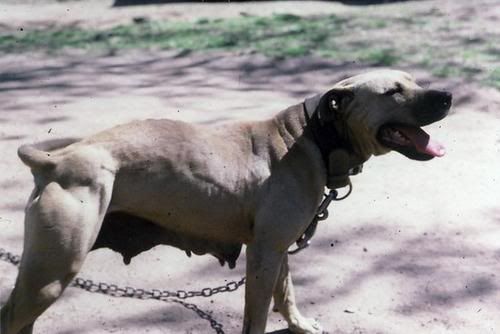
CH. Crenshaw's Honeybunch (3XW) ROM

Before I go any further, Kane is fine and is recovering from his surgery. The student actually dropped the phone as she was talking to me because she was trying to hold onto him and he was moving around. So. I can already tell this is going to be a fun 4 months! She said his miniscus wasn't torn, which was something they were concerned about because of the clicking his knee made when the joint moved. I pick him up tomorrow at 3. Yes, there will be pictures.

Now onto other things to keep my mind occupied.

It's been over a month since I've made up a post about the history of the fighting American Pit Bull Terrier. We've gone over a general history of the APBT and the Official (Cajun) Rules of Dog Matching. Now we delve into the dogs that made the APBT the breed it is today.

CH. Crenshaw's Honeybunch (3XW) ROM


Honeybunch is, without argument, the most influential dog in the American Pit Bull Terrier history. It's safe to say that if you follow any (well-bred) APBT's bloodline all the way back, you will find Honeybunch blood somewhere in there. She was the best producing bitch of all times, producing so many champions it makes your head spin.


4 GENERATION PEDIGREE
FirstSecondThirdFourth
(Sire) WALLING'S BULLYSON (2XW)(1XL)BOUDREAUX' ELI (2XW)BOUDREAUX' SCRUB (1XL)BOUDREAUX' BLIND BILLY (1XW)(1XL)
BOUDREAUX' LENA
BOUDREAUX' CANDYBOUDREAUX' BLIND BILLY (1XW)(1XL)
SHERRER'S TAMMY
BOUDREAUX' SPOOKBOUDREAUX' BOZE (1XW)BOUDREAUX' SCRUB (1XL)
BOUDREAUX' RED
BOUDREAUX' PENNYKINARD'S YOUNG ROCK
BOUDREAUX' PEGGY
(Dam) CARVER'S AMBERCH CARVER'S CRACKER (3XW)(1XL)TUDOR'S DIBO (3XW)HUBBARD'S BOUNCE
HEINZL'S BAMBI
CARVER'S BLACK WIDOWCANNON'S BLACK SHINE (2XW)
HANSON'S AMBER GIRL
TRAHAN'S BEAUTY TGR CH TRAHAN'S RASCAL (6XW)HUBBARD'S BOUNCE
CORVINO'S MAKE UP
CARVER'S BLACK WIDOWCANNON'S BLACK SHINE (2XW)
HANSON'S AMBER GIRL


As you can see from her pedigree, she has heavy Boudreaux blood on both her sire's side and her dam's, which is a little less obvious. Some of Trahan's stock comes from Boudreaux blood, and Boudreaux has stated that he has the papers to show that GR. CH. Trahan's Rascal is registered under his name. The Corvino and Carver dogs also come from Boudreaux blood.


General History:


Ch. Crenshaw's Honeybunch ROM was born at Maurice Carver's Kennel and was a daughter of famed Walling's Bullyson ROM and Carver's Amber ROM. Both dogs belonged to Maurice Carver. In 1972, James Crenshaw bought Honeybunch as a puppy from Maurice Carver and told him: this puppy has everything to become a fundamental pivot in American Pit Bull Terrier selection, and she did do justice to this notion. Honeybunch established her reign in dog matching, winning 3 games against the best bitches of that time (in :51, :28, and 1:19; the last bitch having scratched back twice).


James Crenshaw coupled Honeybunch 7 times with the best pit bulls of that era:


Finley Ch. Bo ROM; Crenshaw's Ch. Otis ROM; Crenshaw's Ch Rascal ROM; Gr Ch Adams' Zebo ROM; Irish Jerry's Trim Moody ROM; Wood's Oso Negro ROM (her only lack-luster litter in terms of producing game dogs); and Arevalo's JR ROM.


Many champions and grand champions resulted from these litters, most notably Crenshaw Ch Jeep ROM (another pivotal dog in APBT history). Other great dogs are:


Crenshaw's Ch. Charlie ROM; Gr. Ch. Irish Jerry's Weehunt ROM; Gr. Ch. Brabham & Singletons' Snake; Buchanan's Jessie ROM; Creppel's Ch. Punk ROM; Crenshaw's Ch. Crypto ROM; Crenshaw's Dolly ROM; Crenshaw's Missy ROM; Crenshaw's Holly ROM; Crenshaw's Sandy ROM; Crenshaw's Sugar ROM; Garrett's Lady Mira ROM; and Crenshaw's Ch. Rascal Junior ROM.


If you sum up all the matches of Honeybunch's offspring, you discover the figure of 65 fights without any losses.


The Story of Champion Honeybunch
(as told by Irish Jerry in American Gamedog Times)


The story of CHAMPION HONEYBUNCH is written as all fighting dog stories, and that is the dog themselves. What can be added to the accomplishments HONEYBUNCH has made as a winner, a champion and a producer. HONEYBUNCH today is regarded as the most influential factor in the history of dog fighting, her amazing ability to produce has proclaimed her the very top producer of all times. It is with great pleasure that I recall some of the events of her life in this exclusive story for the American Gamedog Times. I purchased HONEYBUNCH from Maurice Carver in 1972 as a five month old pup. She was very active as Maurice had told me, I placed her on the chain and watched as she developed into one of the best looking bitches I have ever owned. HONEYBUNCH was a looker, super active on the chain and when rarely caught standing, stood like a great show horse with her legs spread wide apart. HONEYBUNCH was a great looking bitch, but was every bit as good as she looked. Over the years I have had many people and many fanciers to ask questions in regard to HONEYBUNCH'S record, ability, style and general behavior. I will try to answer some of those questions in this story.


THE PIG PICKIN: Some matches were held in the Carolinas in the mid seventies. There was a pig pickin (this is a cliche for BBG) before the matches were to take place. This show was significant because both the great CHAMPION RASCAL and CHAMPION HONEYBUNCH were confiscated as a result of a bust after the fights were held. The complete story of the rescue of these two great a not be told at this time, but both HONEYBUNCH and RASCAL were saved from the wrath of the authorities and were returned to the friendly pit bull dog environment. The complete story of the rescue has been told ad will be documented later. 


RECORD: CHAMPION HONEYBUNCH was matched three times, winning all three! She was conditioned and handled by me in all three of her fights. I have read some advertisements saying she was a five time winner in some old magazines, these ads are sometimes confused with a dogs actual record.


ABILITY: Many great dogs have been criticized for their ability for one reason or another. No dog man that ever saw CHAMPION HONEYBUNCH in action can say that she cut any slack to any of her opponents. In all her matches she took charge from the word PIT and dominated her opponents. No dog could or would scratch back into her after forty minutes. HONEYBUNCH was what we call in the game a main player. Like Tyson in the boxing world, you may not win them all, but the opponent had better come to play.


One person who can testify to HONEYBUNCH'S biting power is Rex B. Rex was the judge for HONEYBUNCH'S second match and was accidentally bitten by her while unfanging her. Rex was working with a breaking stick when HONEYBUNCH clamped onto his thumb. When it appeared to me that the dogs were free I quickly turned HONEYBUNCH from her opponent when Rex said, "Jerry, she still got my thumb". It had been quite a struggle to separate these two fast mouth bitches and I didn't realize HONEYBUNCH was still clamped tight to Rex's thumb. The Old Man on the Mountain replaced Rex as a referee and the match resumed. Rex who is the kind of man who would not yell out in protest or make a big scene, but for the next few days he realized why the Hispanics call the thumb, "Fat Finger".


A LESSON LEARNED: A valuable lesson was taught to me by HONEYBUNCH when she was still a young gyp. A well renowned dog man of the area came to my place to roll a female when HONEYBUNCH was 18 months of age. I was eager to show off my latest Carver acquisition so I took HONEYBUNCH off the chain and faced her up with the experienced brindle bitch. The brindle crossed, took hold of HONEYBUNCH and started to shake, HONEYBUNCH just rolled her big dark brown eyes at me to say, what's going on. The bindle's handler yelled, "I'd shoot that bitch, she won't even fight". I was to proud of my bitch to resort to anything like that, after all she came from the "Old Master" and I placed her back on her chain and decided to wait until another day to show her off.


PRODUCTION: HONEYBUNCH was blessed with the amazing ability to bestow upon her offspring's her own ability to perform as well as produce. HONEYBUNCH was easy to breed, produce large litters of puppies ad raised most of them. This trait coupled with the uncanny ability to reproduce her likeness, has proclaimed her the greatest producer of all times. Her mating career was started after the poor showing verses the brindle female previously mentioned. The choices of studs to be bred to her would also play a large roll in her rapid advance to stardom. The excellent selection of CHAMPION BO, CHAMPION RASCAL and CHAMPION OTIS by James Crenshaw coupled with some older brothers and sisters off of TRIM MOODY and OSO NEGRO from my place caused a pyramid effect and spread the HONEYBUNCH fame around the world.


I bred HONEYBUNCH to TRIM MOODY when she came into heat the second time. TRIM had a very impressive win in 56 minutes before the mating. During the match TRIM suffered damage to his private parts, but came from the bottom to win. I had tested TRIM MOODY before this match ad determined that he was dead game. This mating produced only three surviving males ad all three males became match dogs they were GRAND CHAMPION WEEHUNT, JOKER and BULLY BOB. After HONEYBUNCH weaned this litter I tried her again and really liked what I saw. She was as rough as any female I had ever witness. Her test was her first match and she proved her worth by taking out a very good opponent and scratched so hard that if her foe did not meet her half way, they would be knocked back to the corner wall.


I contacted Dr. Kimsey Wood in an effort to try breed my supped-up little match bitch to OSO NEGRO, I asked if he would agree to a pick. It suited the Doc "OK" and I was just as pleased as OSO NEGRO was building a reputation by kicking bull dog asses around the circuit, at the time. We stuck these two together and produced a litter of nine pups, but only two males. When the picking time came, the doctor said, "Jerry, I sure would hate to take one of those pretty males, I would just as soon take two females". I sent Doc home with two bitches that produced several match dogs as well as reputable producers.


FACT: HONEYBUNCH returned to the four squares to win two more impressive battles. The second of these was the Pig Pickin match famous for the big bust. The opponent in this match was conditioned and handled by Scotty Todd, he was using a good little black female at a weight of 38 1/2 lbs. This was a little heavy for our heroine, but I felt that I would spot a pound or so. I was right, she cut this one down in twenty-eight minutes. One of the pleasures of owning CHAMPION HONEYBUNCH was the superior feeling obtained from watching her work. She was always the same in all her matches, rolling, controlling and always dominating her victim. By the mid-seventies I decided to sell off some of my stock, but didn't want to put HONEYBUNCH on the open market. James Crenshaw had a deep interest in the Carver family as I did, he was very dedicated and a known eye for a good one. HONEYBUNCH'S fighting days were over, but she was in the prime of her producing life. James and I reached an agreement of sale and both of us reaped the harvest of the fruits of his great vine even up to today.


TRUTH: The world of THE AMERICAN GAMEDOG was upgraded by the life of CHAMPION HONEYBUNCH. The dog fraternity will continue to improve as a result of her existence. The augments in regard to her offspring will continue for years to come.


QUESTIONS: The question has been asked many times which of HONEYBUNCH'S litters was the best? Which of her offspring was the best?


These questions will still be asked after all of us are long gone. Crenshaw and I agree on the complicated nature of this question, even after seeing the results of each litter.


My view is, how do you or where do you find a litter that can compare to the records of champions JEEP, CHARLIE and HOLLY? Eleven wins and no losses were recorded by the trio. HONEYBUNCH'S first litter however in which all three males were matched, won ten and lost only two. The accomplishments of GRAND CHAMPION SNAKE can not be ignored either in the search for the best, OTIS also produced others of recognition, in this litter.


When it comes down to the big question of which offspring was best? It really puts you in a bind. Crenshaw and I agree CHAMPION CHARLIE was a better athlete than JEEP, but that the JEEP dynasty is now in a full bloom with the prime status and the unprecedented 15 point ROM ranking and is sure to go higher. 


GRAND CHAMPION WEEHUNT can not be overlooked either. Although he was an impressive, barn storming type of dog. he always gave me his best and won six consecutive matches verses the competition of the time. His first win was at Crenshaw's place when matched into a five time winner called TIGER. TIGER was a veteran of six matches at the time. The Florida boys told me that TIGER had been matched when he was 18 months old and was picked up after making a good showing against the older and possibly better dog. TIGER returned to win five and met WEEHUNT for his seventh time out. WEEHUNT took a pretty good beating and came from the bottom to win in one hour and twenty eight minutes. I was once accused of picking a soft spot for WEEHUNT when I agreed to match into a one time winner in the Volunteer state, instead of a two time winner in the Low Lands. Well as fate would have it, WEEHUNT defeated the one time winner, the two time winner from the Low Lands lost to another two time winner. WEEHUNT then went on to beat the winner of that match when he went for his fourth triumph. I once won two matches in three weeks when I substituted WEEHUNT for another male I had matched at 38 1/2 lbs. I matched WEEHUNT at 37 lbs just three weeks earlier. He got lucky and ran DD from Florida's entrant out of the square in 5 minutes. 


WEEHUNT'S record was six and zero, but to say he was the best in the company of CHAMPION HOLLY, CHAMPION JEEP or GRAND CHAMPION SNAKE is a dilemma that defies a simple solution. CHAMPION HOLLY ranks among the best bitches I have ever seen and in my mind may be HONEYBUNCH'S best offspring. HONEYBUNCH also produced litters from OSO NEGRO, RASCAL and TRIM MOODY. Yielding brood stock that in turn produced the famous MOUNTAIN MAN'S CHAMPION HOMER strain, SNAKEMAN'S GRAND CHAMPION PEDRO, FLIM FLAM, CHAMPION BUBBA, CHAMPION SANDMAN (SANDMAN was also a grandson of JEEP as well as RASCAL JR.) and many more.


Every time you open your Sporting Dog Journal there is a new champion with our star HONEYBUNCH in the third, fourth or now fifth generation and another notch or two added to JEEP'S ROM status. 


CONTROVERSY: Yes, even the greatest of the great must also be subjected to the possibility of someone who may enter a bogus name onto a pedigree. the last question I will try to answer in this story and the bottom line of the is: "OK Maurice, If HONEYBUNCH really was sired by a Spanish Pointer, could you please send me one more just like her!" After one of HONEYBUNCH'S impressive wins I called Maurice to brag of her win. I told Maurice, "She sure can bite" he replied, "Well God Dam son, she's got a license too." 


ACKNOWLEDGMENT: The fame of HONEYBUNCH would not be as vivid had it not been for the many contributions of several breeders including Crenshaw and myself. The others that were key breeders of this family have been James Garrett, Gene Smith, George Wilcox, M. Stover, E. Reece along with a host of others who believed in this line and has helped in the advance of this famous strain of dogs. Last but most, The San Antonio Rose as Don Mayfield called him, The Immortal Maurice Carver.


FUTURE: It has been said that HONEYBUNCH could produce match dogs from a German Shepard and I can't deny or confirm that. I will say, "I guess there will never be another one like her". We will continue to breed and somewhere in the back of our minds we will hope to find one who will fill her collar.


In closing, I want to relate to you something that happened the other day as I was recently visiting a local Wal-Mart. I overheard a conversation between two young men, one of them was a apparently a Pitbull owner and the other youngster a friend of an owner. The conversation went something like this: "Your friend got good dogs man?" Reply: "Yeah man, he has got some real rollin stones". Owner: "He got any Dibo blood, Blood?" Reply: "Yeah man, I don't know if I heard of that one or not." Owner: "How about HONEYBUNCH?" Reply: "Yeah man, I've heard of that one." I nodded to them as I pushed my shopping cart loaded with Ole Roy by them as my mind went to remembering the great CHAMPION HONEYBUNCH R.O.M.


I do not promote, support, or condone any violations of the Animal Welfare Act of 1976, and/or any other local/state/federal laws. I am not affiliated with dog fighting in any way, shape, or form; I am simply a pet owner and enthusiast of the American Pit Bull Terrier and the great history and legacy handed down through the generations. I believe it is important to know where we come from to see where we are going. The articles posted are strictly for historical and educational purposes only; I do not necessarily reflect the views expressed within these articles.

July 6, 2011

The Official Rules of Dog Matching.

These are the Cajun rules of dog matching (which, if you want to get into the technical side of these terms, is not the same as "dog fighting".) In countries where this sport is still legal (or not as heavily enforced if it is illegal), these are the rules they follow to make the match legitimate (with some variation). I will highlight the rules I think are important, as well as explain some terms and rules in brackets, but otherwise let the rules speak for themselves.

Rule 1: The principals shall select a referee who is familiar with the rules and who is satisfactory to both sides. The referee will then appoint his timekeeper. Each handler will select a man to act as his chief second or cornerman, whose duties are to wash the opponent's dog, and to remain near this dog's corner as an observer.

Rule 2: Each handler is to furnish two clean towels and a suitable blanket, to be used by his opponent. Either handler may demand that the opposing handler and his cornerman bare their arms to the elbows; also the handler may taste his opponent's dog's water before or after the contest (up until the referee has rendered his decision on the contest). [This is to prevent any cheating, such as rubbing the dog down with something foul-tasting or poisonous, or adding pain-killer or steroids to the water.]

Rule 3: No water, sponges, towels or any other accessories are allowed in the pit at any time, except the referee who shall have in his possession an adequate breaking stick and a pencil; also a copy of these rules. The pit shall not be less than 16 feet each way, whenever possible, with a canvas-covered floor, upon which has been painted or chalked on, 12.5 feet apart, and with a center-line half way between the scratch-lines. [Scratch-line refers to "a line drawn across the corner of the pit from which the dog must not cross until the referee says to let go".]

Rule 4: The referee shall toss a coin to be called by the handlers. The winner of the toss shall decide which dog shall be washed first and also have the choice of corners.

Rule 5: The dogs shall be washed at pit-side in warm in water and some approved washing powders and then rinsed. The first dog to be washed shall be brought in and held in the tub by his handler and washed by the opposing cornerman. When pronounced clean by the referee, the dog shall be rinsed clean in a separate tub of warm water and toweled dry as possible, then wrapped in the blanket provided and carried to his appointed corner by his handler and accompanied by the man who washed him. These are the only two persons allowed near this dog until the dogs are let go. The other dog shall now be brought in and held in the tub by his handler and washed (in the same water) by the opposing cornerman. When this dog is pronounced clean by the referee and rinsed clean and toweled dry, he shall then be carried to his corner by his handler and accompanied by the man who washed him.

Rule 6: The referee shall now ask "Are both corners ready?" If so, "Cornermen, out of the pit"..."Face your dogs"... "Let Go" The timekeeper shall note the time and write it down for future reference.

Rule 7: Any dog who jumps the pit is automatically the loser of the contest and no scratches are necessary, and no dog is required or allowed to scratch to a dead dog. The live dog is the winner. [Scratch refers to "a dogs willingness to cross the pit and take hold of his opponent according to the rules of the match agreed upon".] 

Rule 8: Should either dog become fanged [Fanged refers to when a fang has punctured the dog's lip and become caught], the referee shall instruct the handlers to take hold of their dogs and try to hold them still so the handler can try to unfang his dog. If this isn't possible, the referee shall separate the dogs with the proper breaking stick and then unfang the dog using a pencil. The referee will then order the handlers to set their dogs down near the center of the Pit and approximately two feet apart. The referee will then order "Let Go". This in no way constitutes a turn or a handle and has no bearing of the future scratches. [Turn refers to "when a pit dog turns his head and shoulders away from his opponent. Official turns are described different in various sets of rules"; a handle refers to "manage a pit dog in a pit contest; the tail, looks similar to a pump handle and has a hand grip after the root, in line with the croup. Once held to start and stop a contest".]

Rule 9: This is to be a fair scratch-in-turn contest until the dogs quit fighting, then Rule 13 shall take over. The first dog to turn must scratch first; thereafter they are to scratch alternately (regardless of which dog turns) until one dog fails to scratch and thereby loses the contest.

Rule 10: To be a fair turn, the dog accused of turning must turn his head and shoulders and his front feet away from the opponent and regardless of whether or not the dogs are otherwise touching.

Rule 11: The referee shall call all turns, although either handler may ask for a turn on either dog. If the referee rules there has been a turn, he will instruct the handlers to "pick up free of holds" [hold refers to when a dog has grabbed their opponent] as soon as possible, and should either dog accidentally get a hold again, the handlers shall set the dogs down immediately and make a continued effort to pick up the dogs, free of holds. When picked up, the dogs must be taken to their respective corners and faced away from their opponent. The timekeeper shall note the time and take up the count (not out loud) and also the referee shall notify the handler whose dog must scratch.

Rule 12: At 25 seconds, the timekeeper shall call out "Get Ready". At these instructions each handler must toe his scratch-line and face his dog toward his opponent with his dog's head and shoulders showing fair from between his handler's legs, and the dog's four feet on the canvas floor. At the 30 seconds, the timekeeper calls out "Let Go" and the handler whose dog must scratch must instantly take his hands away from all contact with his dog and also release all leg pressure from against the dog's body. And the dog must instantly start across and the handler must remain behind his scratch-line until his dog has completed his scratch or the referee has ruled upon it.


There is no time limit on the time required to complete this scratch. But, when released at the words "Let Go" the dog must start across at his opponent. He may waver from direct line, fall down, crawl...drag or push himself across, so long as he makes a continued effort and DOES NOT HESITATE OR STOP until he has reached out and touched his opponent. The opposing handler may release his dog any time he sees fit after the order to "Let Go" however, he must do so as soon as the dogs have touched each other.

Rule 12A: This is an alternate rule for those handlers who wish to have their dogs counted out in the corner. It is the same in all respects as Rule 12, except that after 30 seconds, when the timekeeper calls out "Let Go" the referee shall count our loud, at as near one-second intervals as possible, ONE...TWO...TIME (three seconds), and the dog must be out of his corner and on his way before the referee calls "time" or lose.

Rule 13: If the dogs have apparently quit fighting, whether they are helpless, tired out or curred out [cur refers to a dog which has given up], and regardless of whether both dogs are down or one dog is down and the other dog is standing over him, but neither dog has a hold, the referee shall ask if they are willing to scratch-it-out to a win or not. If so, they shall proceed to do so, but if either handler is unwilling, then the referee shall instruct the timekeeper to note the time and call time in two minutes.


If either dog breaks time, then nothing has changed, but if, at the end of the two minutes, the dogs are in the same relative positions and neither dog has a hold, the referee shall order the handlers to handle (PICK UP FREE OF HOLDS) their dogs. When picked up, the dogs shall be taken to their corners and the corner procedure is the same as in a normally called turn and handle. If there have been no previous turns or handles to establish the order of scratching, the dog who has been the longest without a hold (usually the down dog) to be scratched first, then, as soon as free of holds, the dogs shall be picked up and the other dog scratched.


Should one dog fail or refuse his scratch, then the dog who failed shall lose the contest. If both dogs fail to scratch, the referee shall call it a no contest, but should both dogs make their initial scratches, the handlers by mutual agreement may ask the referee for a draw decision. The referee will then rule it a draw.


Otherwise the contest shall continue, but in this manner: any time the dogs are not in holds and not fighting, the referee shall order the dogs to be handled and scratched alternately until one dog fails to scratch and thereby loses. No attention is paid to turns (after Rule 13 is invoked) except as a possible chance to handle.

THE REFEREE HAS FULL AUTHORITY AND HIS DECISION IS FINAL IN ALL MATTERS.

Rule 14: Fouls that will be just cause for losing a contest:

A. To leave the pit, with or without the dog before the referee has ruled. 
B. To receive anything from outside the pit, or allow anyone outside the pit to touch or assist the dog. 
C. To push, drum, throw or spank, or in any way assist a dog across his scratch-line, except by encouraging him by voice. 
D. To step across a scratch-line before the dog has completed his scratch or the referee has ruled on it. 
E. To stomp on the pit floor or kick the pit sides, yell at of give orders to the opponent's dog, or (in the referee's opinion) do anything to distract or interfere with either dog while scratching or fighting to affect the outcome of the contest. 
F. To interfere with the opposing handler or touch either dog until the referee gives an order to handle the dogs. 
G. To use a "Rub", "Poison", or "Hypo" on either dog.

Rule 15: If there should be any outside interference before the contest has been concluded, the referee has full authority to call it a "NO CONTEST" and shall name the time and place the contest is to be resumed and fought out to a referee's decision. (The same referee shall preside.) Also, the referee shall insist that the dogs be washed and weighed (in the referee's presence), and the dogs shall weigh at the weights specified in the original articles of agreement, and to do this as many times as necessary to conclude the contest.

CAJUN RULES VARIATIONS

Instead of Rule 12A in which a dog has three seconds to leave his corner, he is usually given ten seconds to cross to the other dog.

A 30-second out-of-hold count is generally used, and the down dog must always scratch first (unless both dogs are down with neither in a position of advantage).

The pit may be covered with carpeting rather than canvas (Rule 3), the scratch lines may consist of some of the modern tapes, and the central line between the scratch line is often omitted.


I do not promote, support, or condone any violations of the Animal Welfare Act of 1976, and/or any other local/state/federal laws. I am not affiliated with dog fighting in any way, shape, or form; I am simply a pet owner and enthusiast of the American Pit Bull Terrier and the great history and legacy handed down through the generations. I believe it is important to know where we come from to see where we are going. The articles posted are strictly for historical and educational purposes only; I do not necessarily reflect the views expressed within these articles.